

“Do I need a TAE to teach lash courses?”
This is one of the most common questions searched by beauty professionals who want to scale beyond the chair.
Let’s clarify it properly.
Because the answer depends on how you want to operate.
What Is a TAE and When Is It Required?
TAE stands for Training and Assessment qualification.
If you want to deliver nationally recognised training under the Australian Qualifications Framework, you must:
- Work under a Registered Training Organisation (RTO)
- Hold the appropriate TAE qualification
- Deliver accredited units
- Follow national training compliance standards
If you want to issue nationally recognised Statements of Attainment, a TAE is required.
Can You Teach Lash Courses Without a TAE?
Yes.
If you are delivering private, non-accredited training, you technically do not need a TAE.
However, here is what most people do not consider.
Just because you can teach privately without a TAE does not mean you should ignore:
- Curriculum structure
- Insurance compliance
- Learning outcomes
- Professional documentation
- Student assessment
Many educators launch weekend courses without understanding compliance, structure, or long-term positioning.
That is where credibility suffers.
Accredited Lash Course vs Private Lash Training
Here is the difference.
Private Lash Training
-
Independently created
-
Not nationally recognised
-
No RTO required
-
Quality varies significantly
Accredited Beauty Courses
-
Delivered under an RTO
-
Nationally recognised units
-
Require compliance and assessment
-
Require formal trainer qualifications
If you are serious about becoming a beauty educator long-term, understanding this distinction is critical.
What About RPL for Lash Educators?
If you already have industry experience, Recognition of Prior Learning (RPL) allows you to gain nationally recognised units based on your experience.
Search terms your audience uses:
-
lash RPL Australia
-
how to get accredited to teach lashes
-
nationally recognised lash educator
At International Lash Masters, we offer structured RPL pathways for beauty professionals who want to align with nationally recognised units without starting from scratch.
Because becoming an educator should elevate your authority, not create compliance risks.
The Real Question: What Type of Educator Do You Want to Be?
You can:
-
Run informal weekend workshops
-
Deliver structured private training
-
Align with accredited units and build long-term credibility
Your choice impacts:
- Your pricing power
- Your authority positioning
- Your scalability
- Your long-term brand equity
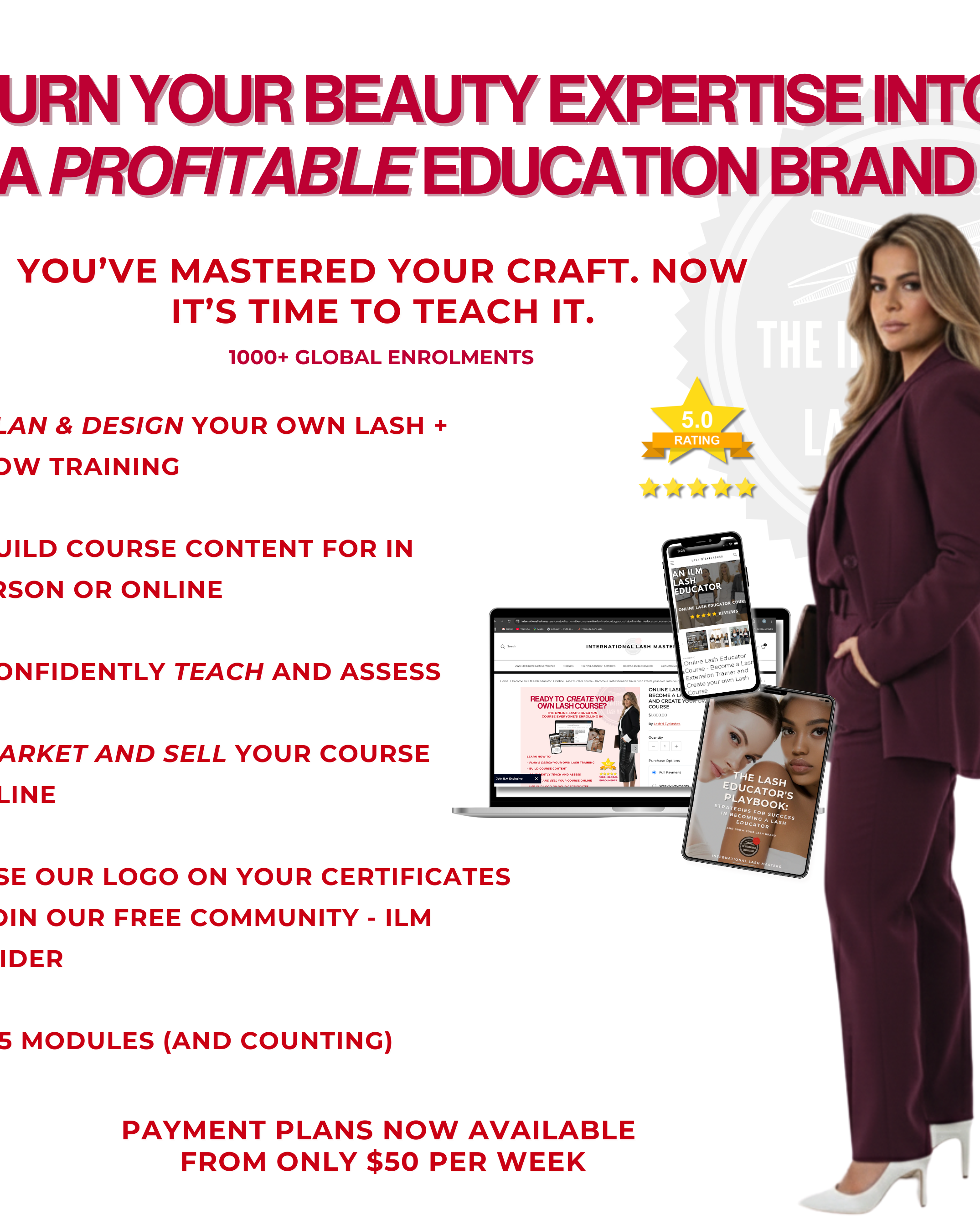
This is exactly why we built the ILM Beauty Educator Course.
When I stepped into education, there was no roadmap. No clarity around TAE, RPL, compliance, or curriculum design.
So we built it properly.
Our Educator Course helps beauty professionals:
- Structure their course correctly
- Design curriculum with clear learning outcomes
- Understand compliance basics
- Build authority before launching
- Launch strategically
And for those wanting to pursue formal recognition, our RPL pathways align with nationally recognised beauty units.
How to Become a Lash or Brow Educator the Right Way
If you are searching:
- how to start a lash training business
- how to create a lash course
- how to become a beauty educator in Australia
The pathway is not just technical skill.
It is structure.
- It is positioning.
It is compliance awareness.
And it is strategic launch execution.
That is what separates hobby trainers from industry leaders.
Final Thoughts
You do not always need a TAE to teach lash courses.
But you do need:
- Structure
- Strategy
- Credibility
- Long-term vision
If you are serious about scaling beyond the chair and becoming a recognised educator, the pathway you choose matters.
If you want support building your course properly, explore our ILM Beauty Educator Course or our RPL pathways for nationally recognised units to ensure you build something credible, scalable, and aligned with industry standards.